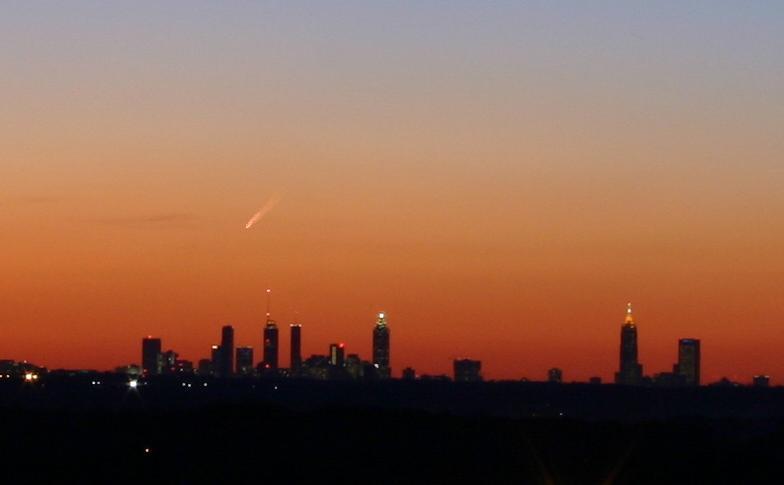
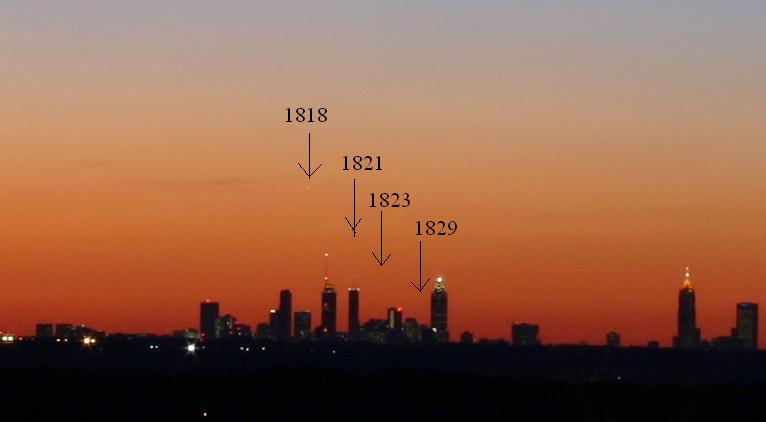
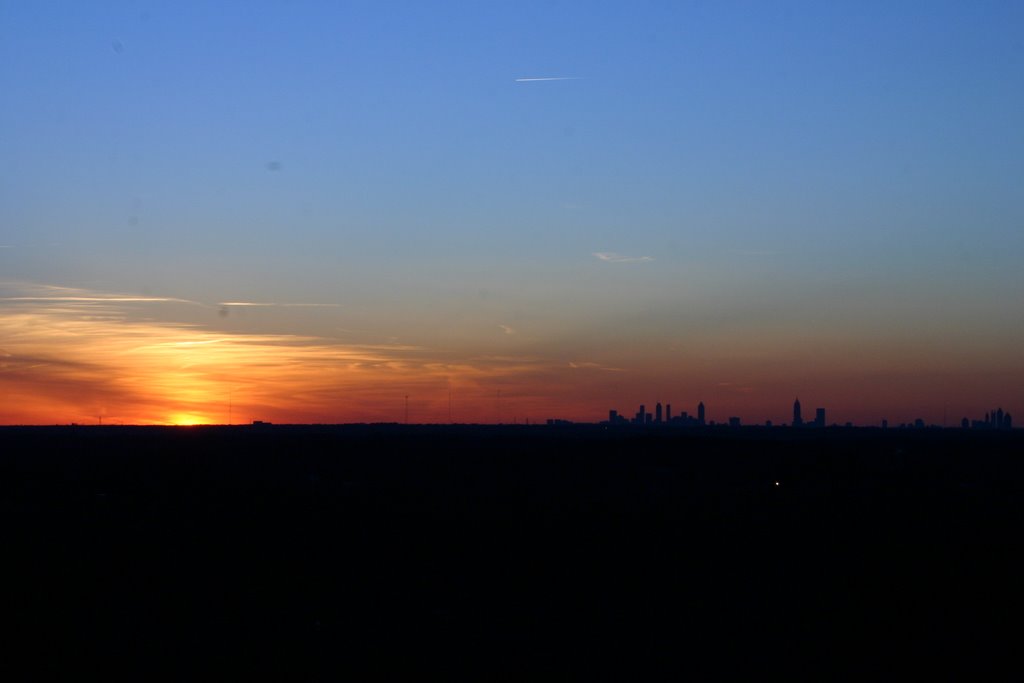
On Wednesday evening, June 20, 2007, I was able to see the Space Shuttle Atlantis and the International Space Station flying in formation.
I took the following 20 second exposure photo with a Canon Rebel digital camera. You can double click the image for a larger view of the photo. The rooftop you see is of my home.
 The Space Shuttle had previously separated from the ISS in preparation for a return to earth. The International Space Station appeared over the somewhat cloudy horizon first, followed by the Atlantis just a wee bit less than 5 degrees behind. The ISS was brighter than the Atlantis.
The ISS appeard 15 degrees over the horizon, 330 degrees NW azimuth.at 22:54:05 local time (Eastern Time). It appeared to be a magnitude 0 or brighter.
The STS 117 appeared at the same location, just seconds later, following 5 degrees or slightly less behind the ISS. The STS 117 appearance as at 22:54:15.
The two flew in formation, both visible at the same time, moving upward above the NNW skies, between Ursa Major and Ursa Minor.
The disappearance into the earth’s shadow was 40 degrees altitude, 345 degrees NNW azimuth. The ISS disappeared first, at 22:55:55, followed by the disappearance of the STS 117 at 22:56:00.
Location of Observer Lawrenceville GA USA
Latitude 33.953052 (use decimal degrees only)
Longitude -83.992469 (use decimal degrees only, east is negative)
Elevation 1031 feet
Instrument Used: Unaided Eye, Canon Rebel digital camera
Element Set Satellite
ISS 1 25544U 98067A 07171.12363426 .00005766 00000-0 36804-4 0 42892 25544 51.6360 88.7334 0007500 341.6186 231.2152 15.78168180491237
STS 117 1 31600U 07024A 07171.04015913 .00011996 00000-0 72294-4 0 2342 31600 51.6352 89.1604 0006674 341.5415 116.7271 15.78174410 1765
Date of Element Set Used: 2007 June 21, 2007
I used http://www.heavens-above.com/main.aspx to help predict the event. Took 3 20 second photos.
Below is a report for the Astronomical League. Double click image for a larger view of the report.